



Key takeaways
- Techno-economic analyses help energy companies distinguish between technically promising technologies and those with a realistic path to cost-competitive commercial deployment.
- Applying analyses early allows teams to challenge assumptions, identify economic weaknesses, and avoid committing capital to concepts with a low likelihood of scaling.
- A breakthrough in core technology may not be enough if balance-of-plant equipment, infrastructure, and integration costs dominate total system economics.
- Sensitivity and scenario analysis reveal the performance, cost, market, and financing conditions needed for a technology to succeed outside of pilot deployments.
As Elon Musk has famously said: “Prototypes are easy. Production is hard.”
In the energy sector, many “emerging” technologies fail to achieve commercialization. Even among those that reach the pilot stage, only a small percentage progress toward broader market adoption.
The culprit is seldom technical; it’s overestimating future cost reductions and overlooking the wider system inputs needed to make the product economically viable at scale. By the time those gaps become clear, significant capital may already have been committed.
Avoiding poor investment decisions requires rigorous techno-economic analysis—also known as TEA—from the earliest conceptual stage of a technology. Teams can use TEA to challenge assumptions, set new product-development priorities, make decisive stage-gate choices, and redirect capital from technically promising but economically weak concepts toward solutions with a credible path to profitability.
Techno-economic analyses reveal whether a technology can compete at scale
As its name suggests, a techno-economic analysis evaluates the technical and economic viability of a technology to help answer a fundamental question: Can this technology compete at scale?
By translating future technical performance into potential economic outcomes, a techno-economic analysis provides a fact-based view of a product or technology’s viability. Its objective is to identify cost drivers, highlight uncertainties, and quantify risks early in the development cycle before substantial capital is committed.
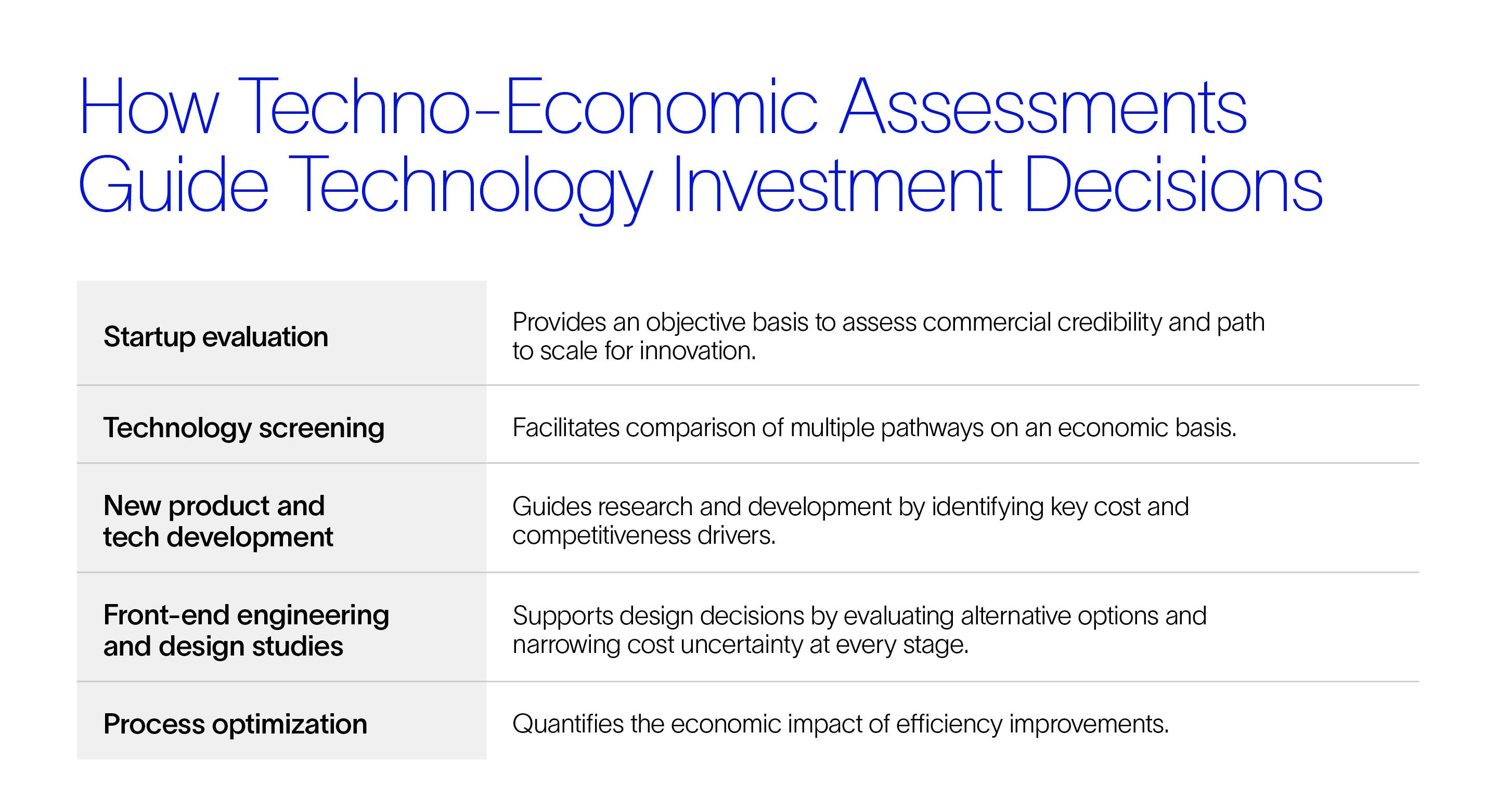
Techno-economic analysis can serve as both an analytical framework and a strategic decision-making tool across the innovation life cycle. Rather than providing a single cost estimate, it connects technical performance, engineering design, market conditions, and financial outcomes to show whether a technology has a credible path to commercial scale through:
- Technology screening—techno-economic analysis provides a consistent basis for comparing competing technologies, process routes, feedstocks, and deployment models. Evaluating each option against common technical and economic assumptions can identify pathways with the strongest commercial potential.
- Portfolio prioritization—within a broader innovation portfolio, techno-economic analysis helps distinguish between scientifically promising technologies and those that can generate economic value at scale. With this knowledge, companies can allocate capital and engineering resources toward opportunities with the best balance of market potential, development risk, and expected return.
- New product development (NPD) guidance—techno-economic analysis identifies the technical parameters with the greatest influence on cost and competitiveness, such as efficiency, equipment life, material consumption, capacity factor, yield, and manufacturing scale. Development teams can then focus research and development (R&D) efforts on improvements that materially strengthen the business case rather than on optimizing performance metrics with limited commercial impact.
- Engineering and design support—before and during front-end engineering and design (FEED), teams can use techno-economic analysis to compare plant configurations, equipment choices, integration strategies, operating conditions, and infrastructure requirements. It helps engineering teams understand the economic consequences of design decisions and avoid locking in costly or unnecessarily complex solutions.
- Process and cost optimization—sensitivity and scenario analysis reveal the variables that most strongly affect project economics, such as energy consumption, feedstock prices, capital intensity, utilization, financing costs, and logistics. Understanding these drivers enables targeted cost reduction, process improvement, and risk mitigation efforts.
- Commercialization and scale-up planning—techno-economic analysis can also test how economics may change as a technology moves from demonstration to mature commercial deployment. Teams can assess realistic learning rates, manufacturing requirements, supply chain constraints, market pricing, and the level of policy support and customer commitment they need at each stage.
Stress testing a techno-economic analysis: Defining what needs to be true
A robust techno-economic analysis goes beyond a single point cost estimate. It tests how the business case changes when key technical, commercial, and financial assumptions move away from the base case. Through sensitivity, scenario, and uncertainty analysis, teams can adjust variables such as capital cost, efficiency, plant utilization, energy prices, operating costs, product value, project schedule, and financing conditions to determine which factors have the greatest influence on economic performance. This type of analysis helps identify:
- Breakeven thresholds—the minimum efficiency, utilization rate, product price, and cost reduction required for the technology to meet its economic targets.
- Key value drivers—the technical and commercial variables that have the largest impact on returns and should receive the most development attention.
- Economic vulnerabilities—assumptions that could quickly undermine the business case if costs rise, performance falls short, deployment is delayed, or market conditions change.
- Critical dependencies—external factors, such as lower-cost electricity, policy incentives, infrastructure availability, and long-term customer commitments, that may be essential to commercial viability.
- Downside exposure—the potential impact of less favorable scenarios on metrics, such as unit production cost, net present value, internal rate of return, and payback period.
By making the assumptions, dependencies, and risks behind the business case visible, techno-economic analysis supports more informed development gate decisions, strengthens investment discipline, and reduces the likelihood of advancing technologies that won’t stay viable under real-world conditions.
Understanding core technology vs. balance of plant
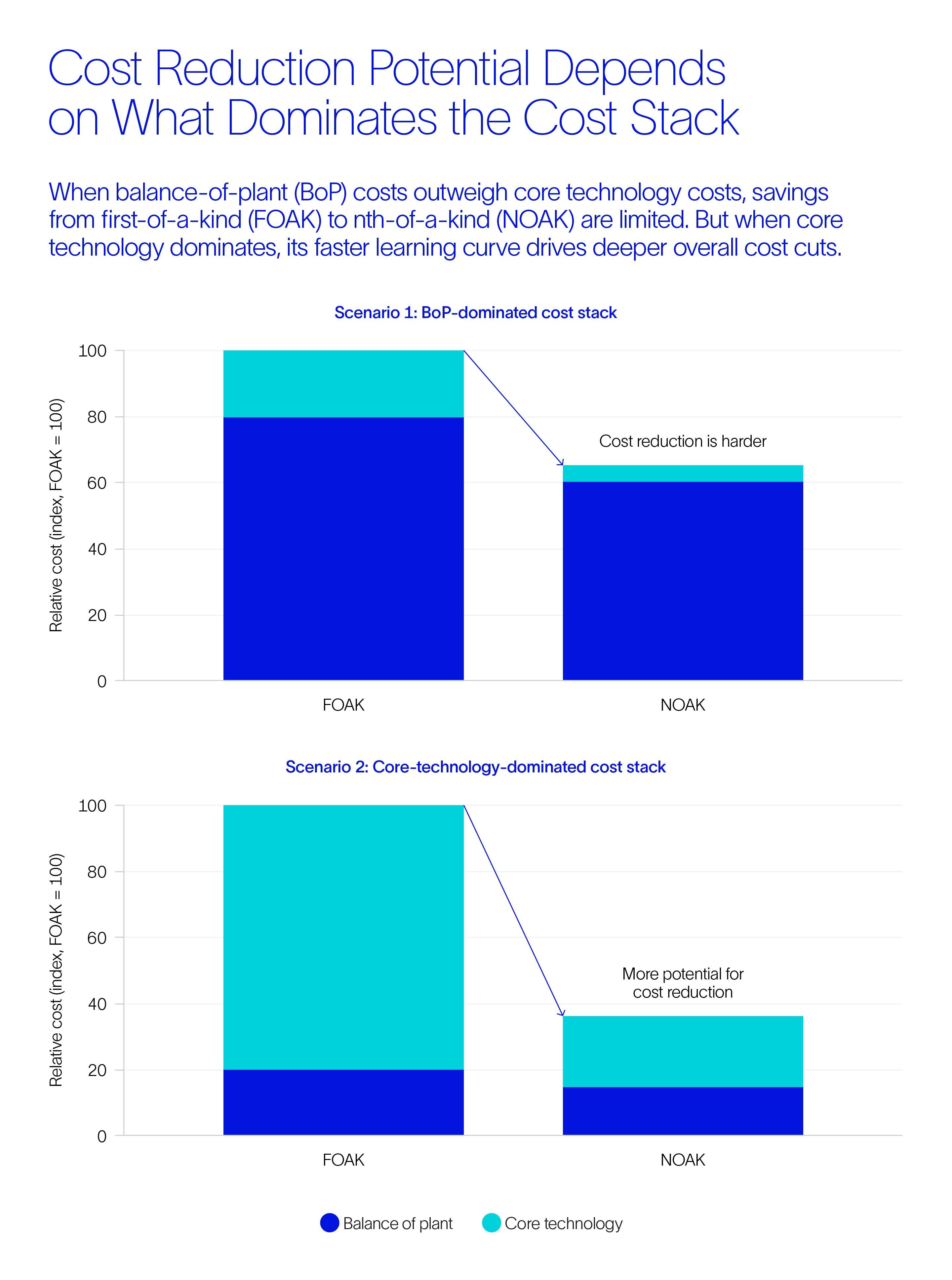
Most emerging energy technologies aren't standalone solutions. They’re part of a larger process flowsheet made up of multiple technology blocks. One block usually contains the core innovation—such as a novel reactor, catalyst, membrane, or capture material—while the surrounding equipment and infrastructure form the balance of plant (BoP).
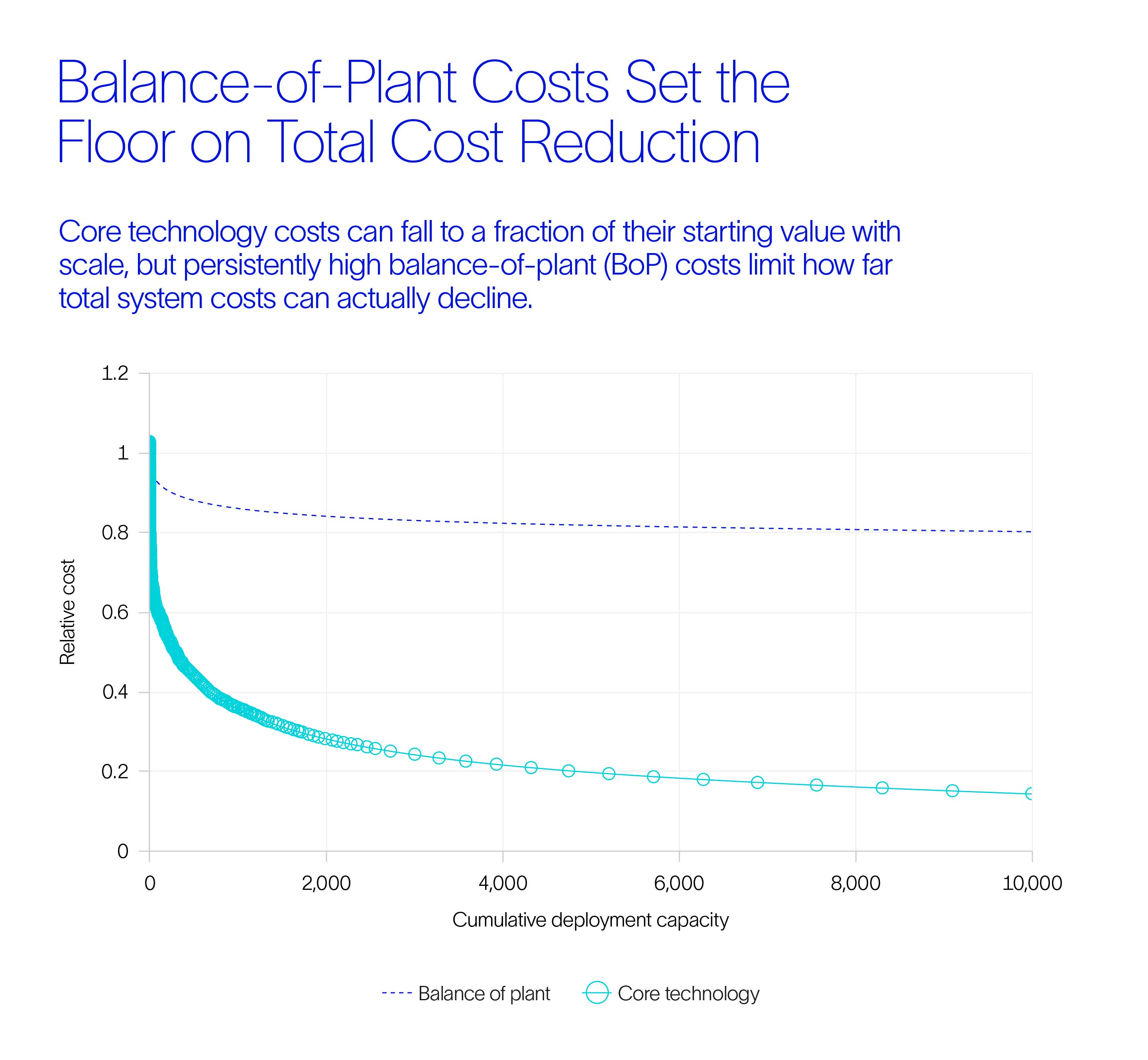
Core technologies may improve rapidly through R&D and learning as they progress from first-of-a-kind (FOAK) to nth-of-a-kind (NOAK) deployment. BoP components, including compressors, heat exchangers, pumps, utilities, and supporting infrastructure, are generally more mature and tend to follow much slower cost reduction trajectories.
Emerging digital and artificial intelligence (AI) technologies do not have a BoP in the traditional physical sense, but their commercial performance still depends on a wider enabling system. The core innovation may be an algorithm, a predictive model, a digital twin, or an autonomous control application, while the surrounding digital balance of system includes sensors, data acquisition and cleansing, connectivity, cloud computing or edge computing, software integration, cybersecurity, model validation, workforce training, and ongoing support.
Techno-economic analysis assesses whether benefits such as increased production, lower energy consumption, reduced downtime, and improved asset utilization justify implementation and life cycle costs. It also tests whether teams can replicate value demonstrated in a pilot across a larger asset base without that value being undermined by poor data quality, integration complexity, computing requirements, or limited user adoption.
In both physical and digital applications, the wider system can account for a substantial share of total implementation and operating costs. As a result, even a breakthrough core technology may not produce a commercially competitive solution if it remains expensive, complex, or difficult to integrate. Techno-economic analysis makes that relationship visible, giving teams a view beyond the core innovation’s performance and an equal focus on system integration, simplification, standardization, scalability, and overall process optimization.
How techno-economic analysis improves the odds of commercial success
Consider an airline evaluating a new generation of fuel-efficient aircraft. Lower fuel consumption may appear to justify fleet renewal, but fuel efficiency is only one variable in a much broader economic system. The business case depends on fuel price exposure, routes, aircraft utilization, maintenance requirements, financing costs, fleet commonality, passenger capacity, residual value, and cost per available seat-mile. A techno-economic assessment identifies the conditions under which the investment creates value, the assumptions most likely to undermine it, and the utilization or fuel price thresholds required to justify deployment. This prevents companies from treating technical improvement as a proxy for commercial success and directs capital toward solutions that strengthen margins across the full operating life.
The same concept can be applied to emerging energy technologies. In such cases, TEA helps prioritize the most critical levers, such as cost per ton in carbon capture and recovery versus capital intensity for advanced mining technologies like direct lithium extraction. The objective is to channel resources to focus on what matters most. By introducing stage-gated decision making tied to clear techno-economic milestones, the analysis brings discipline to NPD funding, enabling early screening, independent validation, and rapid capital reallocation. This approach reduces investment in nonscalable, “risky” projects and shifts the focus from funding many ideas to scaling the right ones.
The importance of credibility in widescale technology adoption
Beyond analysis and decision making, techno-economic analysis provides a transparent, data-driven narrative that demonstrates a clear path to the cost competitiveness of emerging energy technologies, realistic assumptions and risk awareness, and technology and market-demand alignment. The narrative builds trust and credibility with investors, customers, partners, and regulators and reinforces the message that innovation is at the core, but delivering value at scale is the priority.
Ultimately, techno-economic analysis improves decisions before capital, engineering effort, and organizational momentum become difficult to reverse. It reveals when to develop, redesign, advance, or stop—and shifts attention from the most exciting ideas to the solutions that can be built, financed, integrated, and operated competitively.

